
Organizational meta-model design
The Structural Backbone Behind Strategic Transformation

Introduction
Companies continuously create new services to satisfy evolving client demands. As the portfolio expands, those services often become disconnected from one another, fragmenting organizational skills and diluting the strategic purpose of the company itself.
Growing a service catalogue isn’t the problem.
The real issue is that the organization lacks the structural backbone to turn a concept into a repeatable, high-performing system.
Across industries and markets, I’ve seen the same pattern repeat: Leaders try to “upgrade” teams, services, or capabilities, while standing on fragmented foundations.
The outcome is predictable: more activity, minimal transformation, and zero strategic progression.
Real transformation does not emerge from isolated initiatives, new services, or temporary efforts. It emerges from a structural backbone capable of aligning decisions, behaviors, capabilities, and narrative into a single coherent system.
This is precisely why the Organizational Meta-Model exists.
A meta-model is not a methodology. It is the architecture behind a methodology.
Unlike traditional frameworks, the meta-model gives an organization the ability to:
Simplify complexity without trivializing it.
Align teams, services, and leadership under one strategic direction.
Build a _minimum viable model_ today without blocking future scalability.
Move from service delivery to identity-driven transformation.
It is the bridge between what you sell, who you serve, and how your organization actually evolves.
The Three Principles Behind the Meta-Model
Every model is born from a fundamental concept
Any long-lasting model emerges from a central truth about how the organization understands value, change, or transformation.
The model is the structural consequence of that truth.
Real differentiation lives in the ethical framework that surrounds the model
Two models can share similar structures.
Their distinction comes from how they are executed:
How decisions are made
How interventions happen
How teams behave
How the model is embodied in practice
The ethical framework is the element that makes a model distinctive, trustworthy, and strategically unique.
Skills are the cornerstone of the model.
A model only exists if it can be executed. Without the necessary skills, any model remains conceptual and becomes unusable. Skills are what transform an idea into real organizational capability.
Why This Matters Now
The market is entering a phase of structural bifurcation:
Companies that build models will scale.
Companies that sell only services will stagnate.
And companies that improvise will disappear.
Executives know this, but they rarely have the time, clarity or structure to build the bridge themselves.
A meta-model accelerates that construction, reduces risk, shortens transformation cycles, and replaces noise with strategic order.
COMPONENTS OF THE ORGANIZATIONAL META-MODEL
These are the structural elements that an organization must integrate in order to develop its own model:
Ethical Framework: How the company delivers, leads and behaves.
Fundamental Concept: The technical and social backbone.
Services: What exists and what must evolve.
Target Audience: Who the model truly serves.
Context & Market Positioning: Where the model competes and grows.
Journey: The transformation path A → B.
Perspectives : How different areas interpret the model.
Skills: The invisible infrastructure.
Fundamental Questions: Why, What, Who, How.
Delivery Staircase: The evolution from services to a unified model.
These components convert scattered activities into a coherent business engine.
Ethical Framework
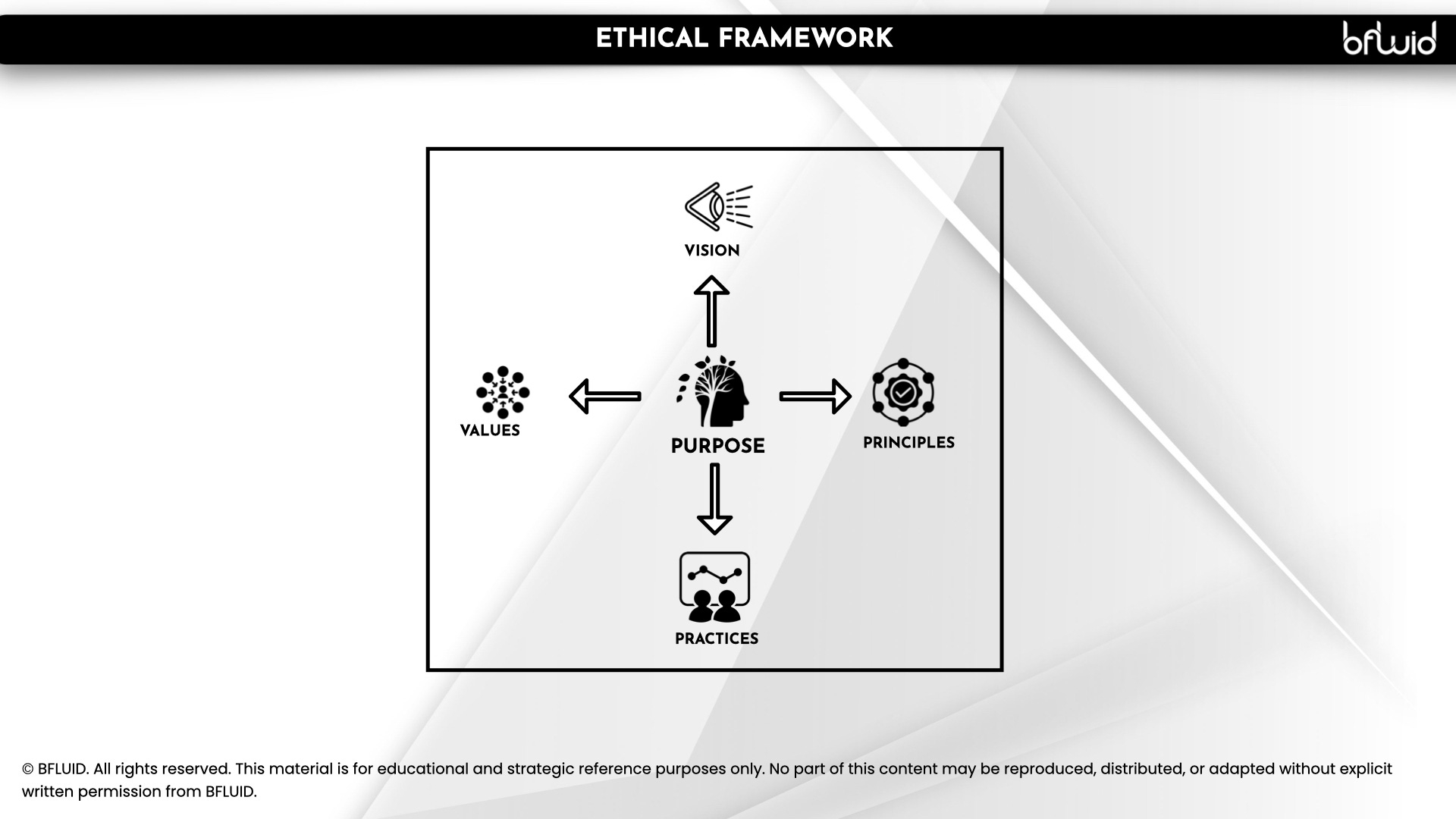
The Ethical Framework defines the rules of coherence, behavior, and professionalism that guide every intervention.
It does not describe the methodology, but rather the ethical and professional manner in which the organization executes that methodology.